51-Year-Old man with rare and life-threatening pancreatic condition, treated successfully via robot-aided surgery at Fortis Vasant Kunj

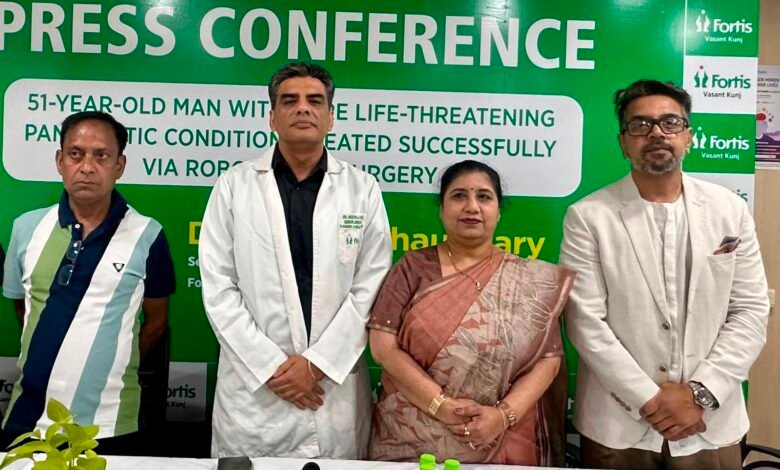
Fortis Hospital Vasant Kunj successfully performed a highly complex robotic pancreatic necrosectomy on a 51-year-old man suffering from Walled-Off Pancreatic Necrosis (WOPN), a rare and potentially life-threatening complication of acute pancreatitis.
The team of doctors led by Dr. Neeraj Chaudhary, Senior Director & Head, GI Surgery, GI Oncology & Robotics, Fortis Hospital Vasant Kunj adopted an advanced minimally invasive robotic procedure to help the patient recover well, significantly reducing the risks of major complications associated with conventional open surgery.
Patient Naveen Kumar Jain was admitted at Fortis Vasant Kunj with recurrent abdominal pain and persistent fever that had continued for nearly two months. He was unable to tolerate solid food and had suffered significant weight loss during this period. Initially, he was 69 kgs, but due to the pancreatic condition, he lost a significant 12kgs. A known diabetic, the patient had also undergone multiple hospital admissions in Sonipat for severe abdominal pain requiring intravenous pain management.
Detailed investigations, including a contrast-enhanced CT scan of the abdomen, revealed a large 6 cm × 6 cm collection of Walled-Off Pancreatic Necrosis, a condition in which dead pancreatic tissue becomes encapsulated and infected following severe pancreatitis. If left untreated, the condition can result in severe infection, internal bleeding, malnutrition, organ dysfunction, and other life-threatening complications.Following a comprehensive evaluation, the multidisciplinary team decided to proceed with a robotic pancreatic necrosectomy along with drainage of the infected collection. During surgery, the doctors encountered extensive inflammation and dense scar tissue surrounding the pancreas. Nearly 450 ml of infected fluid and pus was successfully drained, and the diseased tissue was carefully removed. The robotic platform enabled superior visualisation and precision while operating around major blood vessels and other critical structures. The five-hour procedure was completed successfully, and the patient showed steady improvement post-operatively. He was discharged in a stable condition just five days after the procedure.
Dr. Neeraj Chaudhary, Senior Director & Head, GI Surgery, GI Oncology & Robotics, Fortis Hospital Vasant Kunj, said, “Walled-Off Pancreatic Necrosis is among the most complex complications of pancreatitis and can become life-threatening if not managed at the right time. Surgery in these cases can be complex because scar tissue and anatomical changes make it difficult to access the affected area safely, increasing the risk of complications. Robotic surgery offers superior visualization, enhanced dexterity, and greater precision, allowing us to safely access and clear the infected pancreatic cavity while minimizing trauma to surrounding tissues. Compared to conventional open surgery, robotic pancreatic necrosectomy is associated with lower morbidity, shorter ICU and hospital stays and faster recovery. In this case, timely intervention prevented potentially devastating complications and enabled the patient to return to normal life.” “WOPN remains one of the most challenging pancreatic conditions to treat surgically due to severe inflammation and distorted anatomy associated with the disease. If left untreated, the condition can lead to rupture of the pancreatic collection, life-threatening internal bleeding, severe malnutrition, brittle diabetes and a significant deterioration in quality of life,” he added.
Dr. Gurvinder Kaur, Facility Director, Fortis Hospital, Vasant Kunj said, “The successful management of this highly complex case highlights Fortis Hospital Vasant Kunj’s advanced expertise in robotic gastrointestinal and pancreatic surgery. It reinforces our commitment to delivering cutting-edge, patient-centric care and providing access to the latest surgical innovations for patients with complex and high-risk conditions.”